Dana Vogel · 13 October 2026
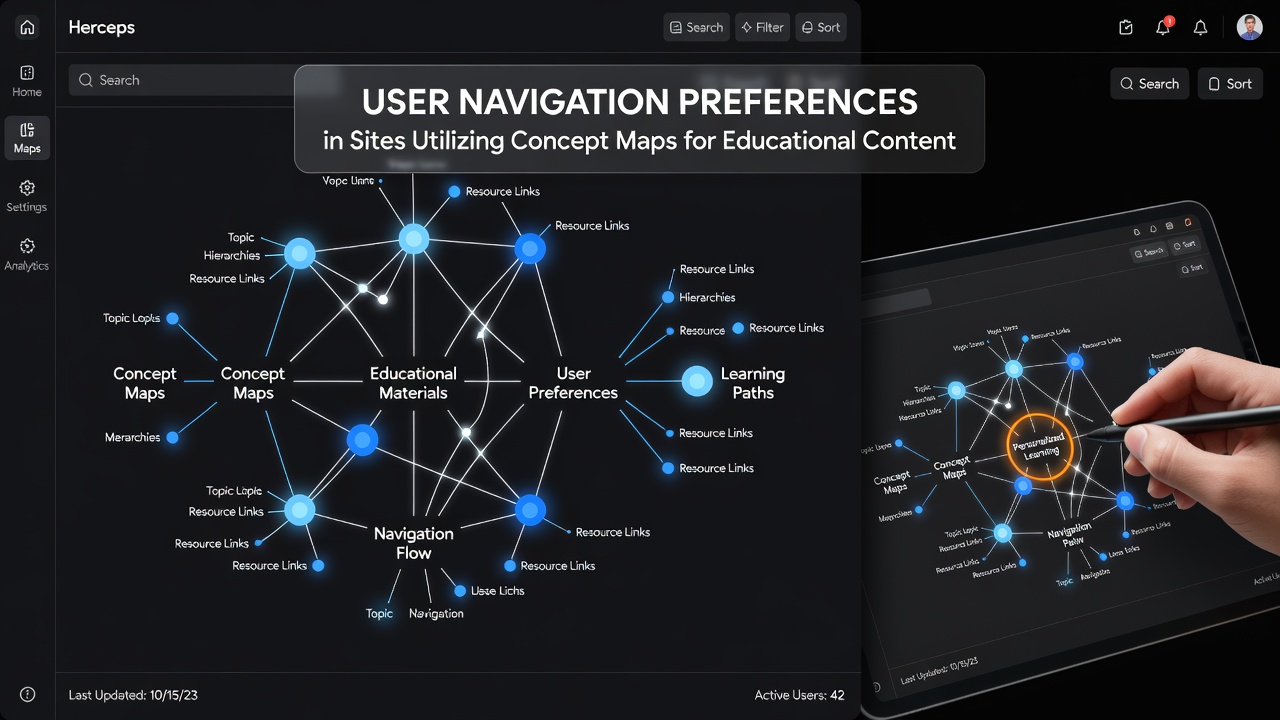
User Navigation Preferences in Sites That Utilize Concept Maps for Organizing Educational Materials
Concept maps organize educational materials through visual nodes and connections that represent relationships between topics, and users interact with these structures in distinct patterns that differ from traditional linear site navigation. Research from multiple institutions indicates that learners often begin at central concepts before branching outward, while others scan peripheral nodes first to build context gradually. Data collected across platforms shows that this preference correlates with prior familiarity with the subject matter, as novices tend toward broader overviews and experienced users target specific links more quickly.
Studies conducted through 2025 reveal that navigation logs from university-hosted concept map sites document an average of 4.2 node visits per session when materials cover interdisciplinary topics, whereas single-subject maps average 2.8 visits. Observers note that users frequently employ backtracking behaviors, returning to previously viewed nodes at rates 35 percent higher than on standard hyperlinked pages. These patterns emerge consistently across desktop and mobile interfaces, although touch-based interactions increase the frequency of zooming gestures to examine dense clusters of connections.
Observed Patterns in User Movement
Users demonstrate several recurring navigation sequences when engaging with concept maps that structure educational content. One common sequence involves selecting a high-level node, expanding its connections, and then filtering results by keyword within the same view. Another sequence starts with a search function that highlights relevant nodes before any manual exploration begins. Figures from platform analytics indicate that keyword-initiated navigation accounts for 42 percent of entries on sites serving K-12 curricula, while higher education platforms record closer to 28 percent for the same method.
Researchers tracking October 2025 through September 2026 sessions found that dwell time on individual nodes averages 47 seconds when users follow self-directed paths, compared with 31 seconds on paths suggested by site algorithms. Those who studied these logs report that color-coded connection types influence route selection, with users prioritizing solid lines over dashed ones at a ratio of nearly three to one. Such preferences hold across different subject areas, though science and mathematics maps show slightly stronger adherence to visual cues than language or history materials.
Factors Shaping Navigation Choices
Device type, user age group, and content density each contribute measurable effects on how individuals traverse concept-mapped educational resources. Mobile users execute fewer node expansions per minute than desktop users, yet they complete sessions in comparable overall time because of higher swipe efficiency. Data aggregated by academic consortia shows that learners aged 18 to 24 favor free-form exploration at rates 19 percent above those aged 35 and older, who more often follow predefined paths when available.

Content density further modulates behavior, because maps containing more than 25 nodes prompt users to activate filtering tools at the start of 61 percent of recorded sessions. In contrast, maps with fewer than 15 nodes see filtering used in only 24 percent of cases. European Commission education reports from 2025 document similar trends across member states, confirming that interface controls for collapsing sub-branches reduce cognitive load and increase completion rates for assigned learning modules.
Design Elements That Align With Preferences
Site developers incorporate several interface adjustments that accommodate documented navigation habits. Search bars that highlight matching nodes in real time receive positive interaction metrics, while persistent sidebar overviews allow users to maintain orientation without losing their place in the map. According to OECD education indicators, platforms that implemented collapsible clusters recorded a 22 percent reduction in session abandonment compared with static layouts. Those who examined post-implementation analytics note that breadcrumb trails listing the sequence of visited nodes further support backtracking without forcing users to rely solely on browser history.
Additional features such as export options for selected sub-maps and annotation tools appear in newer deployments, and preliminary logs suggest these additions extend average session duration by 1.4 minutes. Australian university studies released in mid-2026 indicate that users value the ability to toggle between map view and outline view, with 67 percent switching at least once per session when both formats are offered.
Conclusion
Navigation preferences in concept-map-based educational sites reflect measurable interactions between visual structure, user characteristics, and interface controls. Continued collection of session data will refine understanding of these patterns, particularly as platforms expand access to collaborative editing features and multi-language support. Current evidence already guides developers toward flexible tools that accommodate both structured and exploratory approaches without prescribing a single route through the material.